Keeping an edge: care that actually matters
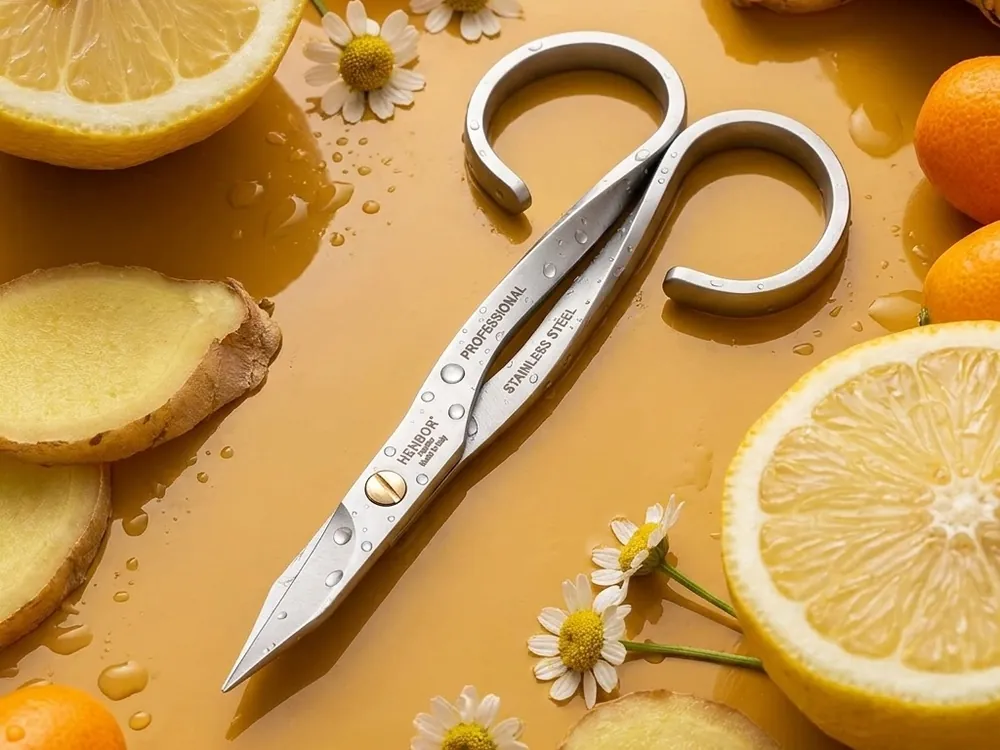
Stainless steel resists corrosion. It is not immune to it, and most instruments that die early are not worn out — they are corroded at the pivot.
Dry it, every time
Water left in the joint is what kills scissors and nippers. After any contact with water, wipe the instrument and open and close it a few times on a dry cloth so the pivot sheds moisture. Then return it to its case.
This is the whole discipline, and it takes ten seconds. Everything below is refinement.
Oil the joint twice a year
One drop of clock oil or sewing machine oil in the pivot, worked through by opening and closing, then the excess wiped off. Not cooking oil — it gums. Not WD-40 — it is a solvent, not a lubricant, and it washes out what little oil is there.
A dry pivot is what makes an instrument feel stiff, and stiffness is what makes people press harder, which is what bends tips.
Store it apart from other steel
Instruments knocking against each other in a drawer chip their own edges. A leather case is not decoration — it is the reason the tips are still pointed in five years. If the instrument came without one, a soft cloth roll does the same job.
Keep the case out of the bathroom if you can. Steam is water, and a closed case in a humid room stays humid for hours after the shower.
Never cut anything but nails and skin
Paper, tape, hair, thread and plastic packaging all dull an edge that was ground for keratin, and they do it within minutes rather than months. A pair of nail scissors used once to open a package will never cut as cleanly again.
This sounds pedantic until you own an instrument worth keeping. The household scissors exist for a reason.
Disinfection without damage
Forged stainless takes disinfectant and autoclaving. What it does not take is being left to air-dry in a tray, which is precisely how salon instruments corrode. The rule is unchanged: dry the joint afterwards, not just the blades.
Alcohol evaporates and is the least aggressive choice for a household. Chlorine-based cleaners pit stainless steel — they belong nowhere near an instrument you intend to keep.
How to know the edge has gone
Two signs, both unmistakable once you know them. First, the window test: closed blades held against the light should show no gap along the cutting edges. Second, the sound and feel — a good edge severs with one motion, a tired one folds the nail and lets it spring back.
A dull instrument is not dangerous, but it is the reason nails split at the corner. The nail was not weak; it was crushed rather than cut.
What wears out and what does not
The steel of a forged instrument does not wear out in a lifetime of household use. What wears is the geometry at the very edge — a few microns of metal — and the tension of the joint. Both are restorable by a grinding workshop, which is why a good instrument is a purchase rather than a consumable.
What is not restorable is a pitted blade. Corrosion removes metal unevenly, and a pitted edge cannot be brought back to a clean line. That is the entire argument for the ten seconds of drying.
A realistic routine
After each use: wipe, open and close on a dry cloth, back in the case. Twice a year: a drop of oil in the pivot. Once a year: hold everything up to the window and see what has changed.
Instruments kept this way stay in service for decades. Our cased sets ship with the case for this reason, and the glossary of steel terms explains what is happening in the metal if you want the longer version.