Glossary of steel and sharpening
Instrument descriptions are written in a vocabulary that sounds technical and is often used decoratively. Surgical steel, hand-finished, hardened — each of those means something specific, and a seller who uses them loosely is usually counting on you not to ask which.
Four things decide how an instrument behaves, and they are worth separating:
- How the blade was shaped. A forged blade is worked from hot bar stock and tapers from joint to tip. A stamped one is punched from cold sheet and keeps one thickness. On a cutting edge under a millimetre wide, that difference is the difference between two edges meeting along their whole length and two edges meeting in the middle.
- How hard the steel is. Measured on the Rockwell scale; nail instruments normally sit at 54–58 HRC. Harder holds an edge longer and chips more readily — which is why higher is not automatically better.
- How the edge was finished. Hand sharpening means a person watched how the two blades closed and corrected it. A convex edge is the shape that lets them close cleanly along a curve.
- Whether it will corrode. Stainless resists rust because of a chromium oxide layer — see passivation. It is not rust-proof, and standing moisture beats it.
If you are trying to work out whether an instrument is what its listing claims, the companion page is how to tell real Solingen: the law, the markings, and what to check before paying.
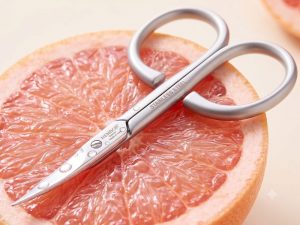
A bevel ground as a curve rather than a flat facet. It puts more steel behind the very edge, which is why fine points survive on convex-ground blades.
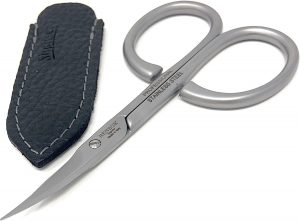
Two ways to get a blade blank. Forging shapes hot steel under force; stamping cuts a cold shape out of sheet. The difference shows up years later.

A file whose abrasive is etched into tempered glass rather than glued on. It sheds no grit, washes clean, and keeps its cut for years.
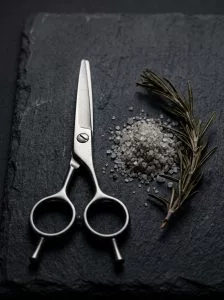
The final edge put on at a wheel by a person who watches how the two blades meet. On curved instruments no machine has replaced this step.
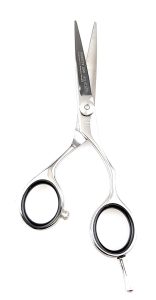
The heat treatment that sets an instrument’s final hardness. Under-hardened steel goes blunt in months; over-hardened steel chips at the tip.
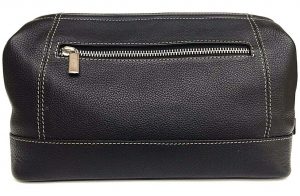
A soft full-grain leather tanned to stay supple. Used for instrument cases because it takes daily handling without cracking at the folds.
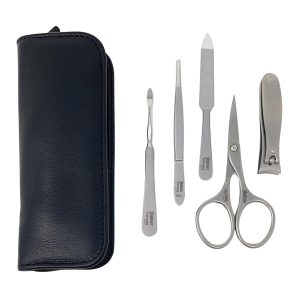
The cutting head of a nipper, measured in millimetres or as a fraction. The longer the jaw, the more it removes per cut — and the less forgiving it is.
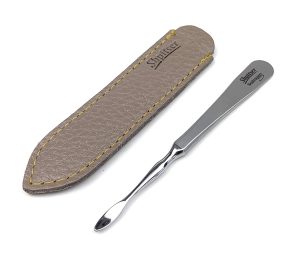
The finishing treatment that builds the chromium oxide layer on stainless steel. It is what makes an instrument stainless — and it can be damaged.
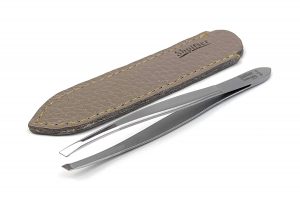
The standard measure of how hard a blade is. Nail instruments sit around 54–58 HRC — high enough to hold an edge, low enough not to chip.
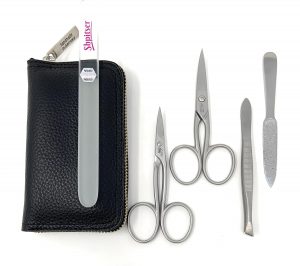
A protected designation of origin for German blades: an instrument may carry the name only if the decisive steps were done in the Solingen district.
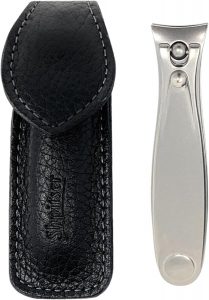
A German martensitic stainless steel used for grooming and surgical instruments — hard enough to take a fine edge, stable enough to resist rust.