Eponychium
The seal at the base of the nail
The eponychium is the fold of living skin lying across the base of the nail plate. Its underside is bonded to the nail, and that bond is a barrier: it keeps water, soap, bacteria and fungal spores out of the pocket where the nail is formed. The visible line people call the cuticle is what this fold sheds onto the advancing nail.
In short
- What it is: living skin fold at the nail base
- Its job: a seal over the nail matrix
- Handling: push back gently after softening; do not cut
Not to be confused with
The cuticle — dead tissue on the plate — and the nail folds along the sides.
Why professionals draw the line here
Nearly every rule about cuticle work exists to protect this fold. It is the reason a technician softens before pushing, uses a rounded pusher rather than a metal edge, and removes only tissue that has already separated. The nail matrix sits a few millimetres underneath; damage there shows up months later as ridges or a distorted plate, long after anyone connects it to the manicure.
Signs it has been over-worked
Redness that does not settle, a thickened white rim, tenderness when pressed. That combination usually means the seal has been broken repeatedly and needs to be left alone to close.
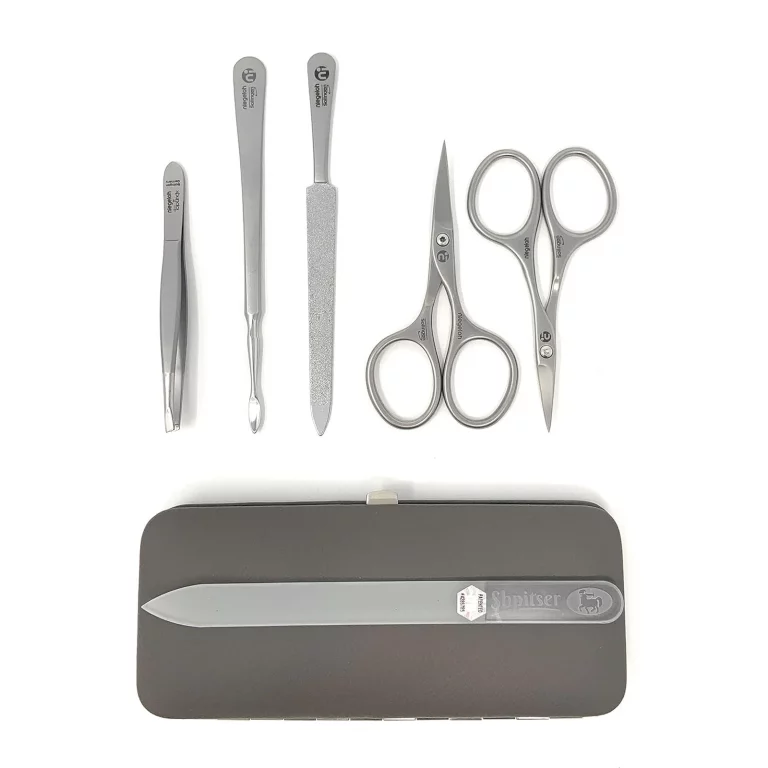
Instruments where this matters
Questions we get
Is the eponychium the same as the cuticle?
No. The eponychium is living skin at the base of the nail; the cuticle is the dead band it leaves behind on the nail plate.
What happens if it is cut?
The seal is broken. Water and bacteria reach the space around the nail root, and the fold often thickens as it heals. Repeated cutting can leave a permanently ragged edge.
Can it be pushed back?
Gently, after softening. Pushing is not cutting, and the aim is to free the dead band rather than to expose more of the nail.
*This page explains a word, nothing more. It is not medical advice and does not replace a consultation about a specific condition of the nail or the skin around it.
The nail itself: layered keratin, formed in the matrix, sliding forward over the bed. Everything else in a manicure is either under it or around it.
The pale half-moon at the base of the nail — the visible front edge of the matrix, where the nail is still forming and still soft.
The thin band of dead tissue that the nail carries out from under the skin fold. It is the part that can be removed — unlike the living fold behind it.
The part of the nail that has grown past the fingertip and is no longer attached to the bed — the only part that is actually being cut or filed.