Hyponychium
The seal under the free edge
Where the nail plate stops being attached to the bed and becomes the free edge, a band of skin closes the junction from underneath. That band is the hyponychium. It keeps water and debris out of the space under the nail, and it is dense with nerve endings — which is why the area is so sensitive when it is exposed.
In short
- Where: under the nail, at the line where the free edge begins
- Its job: sealing the underside against water and bacteria
- Handling: clean gently, never lever anything under the edge
Practical consequence
Cut the free edge back past this line and it will be sore for days. Trim gradually instead.
Cleaning without damaging it
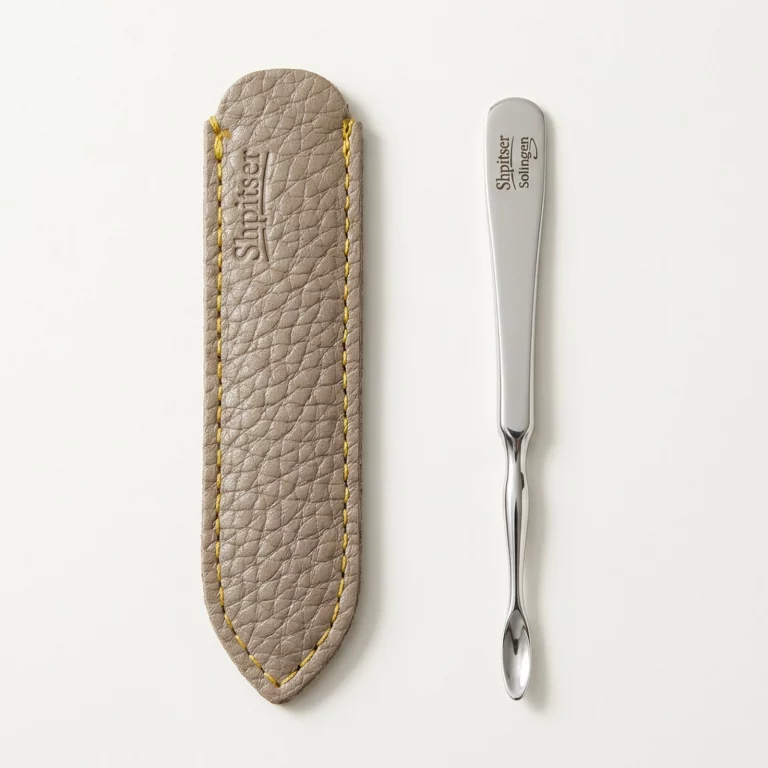
A rounded nail cleaner run along under the edge lifts debris without separating the seal. Sharp implements — a pointed pusher, a scissor tip, a paperclip — do the opposite: they open a gap that then stays open, collects moisture and takes weeks to close.
Why it varies between people
The seal advances with a long nail and retreats when nails are kept short. That adaptation is slow. Someone who has worn long nails for years and cuts them short in one sitting will feel it; the same change made over a few weeks passes unnoticed.
Instruments where this matters
Questions we get
Why does cutting nails very short hurt?
Because the free edge is cut back to where the hyponychium still holds it. That skin is nerve-rich and not meant to be exposed.
Can it be cleaned under the nail?
Yes, gently, with a rounded nail cleaner. Sharp points pushed under the edge separate the seal and open a path for infection.
Why is it longer on some nails?
It advances with a nail that is kept long and retreats slowly when nails are kept short — which is why going short suddenly is uncomfortable, and going short gradually is not.
*This page explains a word, nothing more. It is not medical advice and does not replace a consultation about a specific condition of the nail or the skin around it.
The pale half-moon at the base of the nail — the visible front edge of the matrix, where the nail is still forming and still soft.
The rims of skin framing the nail on three sides. They hold the plate in place and, along the sides, are where most manicure injuries happen.
A strip of skin, not nail, that has torn away beside the nail. Cut it flush — pulling it takes living tissue with it.
The thin band of dead tissue that the nail carries out from under the skin fold. It is the part that can be removed — unlike the living fold behind it.