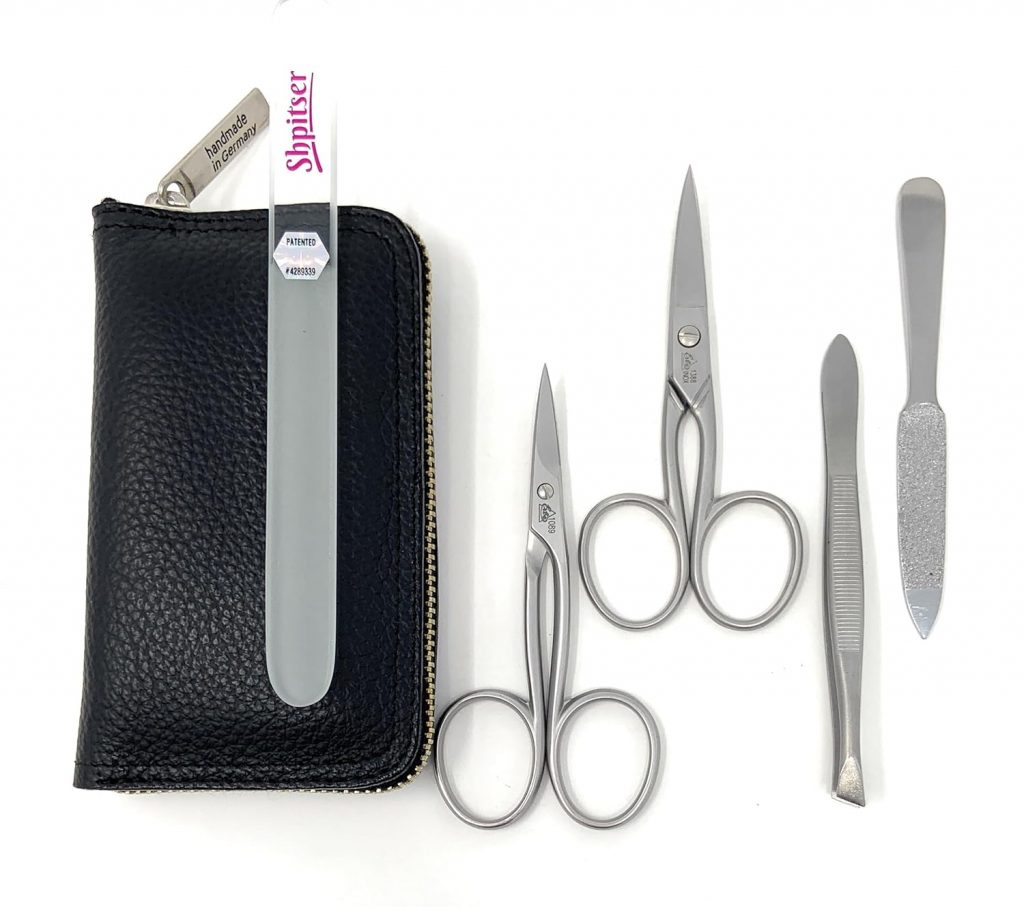
What Solingen means on an instrument
Solingen is a city in North Rhine-Westphalia and, more usefully for a buyer, a protected designation of origin. Under the German Solingen decree of 1938, still in force, the name may appear on a blade only if the steps that decide its quality — forging, hardening, grinding, sharpening and finishing — took place within the Solingen district. Steel bought elsewhere is fine. Blanks stamped elsewhere and merely polished in Solingen are not.
That is the whole legal content of the word. It is narrower than most marketing suggests and more useful than most buyers assume: it tells you the grinding and the heat treatment happened in a place where those trades have been the local occupation for roughly six hundred years.
In short
- Type: protected designation of origin, not a brand and not a steel grade
- What it covers: forging, hardening, grinding, sharpening, finishing
- What it does not cover: where the raw steel was smelted, or how carefully any one workshop works
Not to be confused with
“German steel” and “German design” are unregulated phrases. Either can appear on an instrument made anywhere.
Why the city concentrated the trade
The Wupper river drove grinding wheels long before electricity, ore and coal were close, and the guilds kept the craft inside families. By the nineteenth century the district held hundreds of small grinding shops, each specializing in one shape: razors here, scissors there, nail instruments in a third shop. Much of that structure survives — a workshop with fifteen people making nothing but nippers is still a normal Solingen business.
How to read it on a package
Look for the full phrase Made in Solingen, ideally with the maker named. Vaguer wording — “Solingen quality”, “Solingen tradition”, “German type steel” — carries no legal weight and usually means the decree does not apply.
Our own instruments and the workshops we carry, Niegeloh and Erbe among them, work inside the district. That is why the word appears on the case rather than in the description alone.
Instruments where this matters
Questions we get
Can any company print Solingen on a blade?
No. Since 1938 German law reserves the name for instruments whose essential production steps happen inside the Solingen district. Assembling imported blanks there does not qualify.
Does Solingen guarantee a good instrument?
It guarantees where the work was done, not how carefully. It rules out the cheapest production, but the edge, the closure and the finish still vary between workshops.
Why did knife making end up in one small city?
Water power from the Wupper river, local ore and coal, and guilds that kept the grinding trade in family hands for centuries. The specialization outlasted the reasons for it.
*This page explains a word, nothing more. It is not medical advice and does not replace a consultation about a specific condition of the nail or the skin around it.
The heat treatment that sets an instrument’s final hardness. Under-hardened steel goes blunt in months; over-hardened steel chips at the tip.
A soft full-grain leather tanned to stay supple. Used for instrument cases because it takes daily handling without cracking at the folds.
The finishing treatment that builds the chromium oxide layer on stainless steel. It is what makes an instrument stainless — and it can be damaged.
A bevel ground as a curve rather than a flat facet. It puts more steel behind the very edge, which is why fine points survive on convex-ground blades.