Glossary of steel and sharpening
What the words on an instrument actually mean: the steel, the forging, the edge and the tests it passes before it leaves Solingen.
Instrument descriptions are written in a vocabulary that sounds technical and is often used decoratively. Surgical steel, hand-finished, hardened — each of those means something specific, and a seller who uses them loosely is usually counting on you not to ask which.
Four things decide how an instrument behaves, and they are worth separating:
- How the blade was shaped. A forged blade is worked from hot bar stock and tapers from joint to tip. A stamped one is punched from cold sheet and keeps one thickness. On a cutting edge under a millimetre wide, that difference is the difference between two edges meeting along their whole length and two edges meeting in the middle.
- How hard the steel is. Measured on the Rockwell scale; nail instruments normally sit at 54–58 HRC. Harder holds an edge longer and chips more readily — which is why higher is not automatically better.
- How the edge was finished. Hand sharpening means a person watched how the two blades closed and corrected it. A convex edge is the shape that lets them close cleanly along a curve.
- Whether it will corrode. Stainless resists rust because of a chromium oxide layer — see passivation. It is not rust-proof, and standing moisture beats it.
If you are trying to work out whether an instrument is what its listing claims, the companion page is how to tell real Solingen: the law, the markings, and what to check before paying.
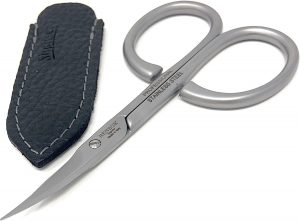
Two ways to get a blade blank. Forging shapes hot steel under force; stamping cuts a cold shape out of sheet. The difference shows up years later.